Why SVPWM Gives About 15% More Voltage Than SPWM, and Why the Number Changes With Your Definition
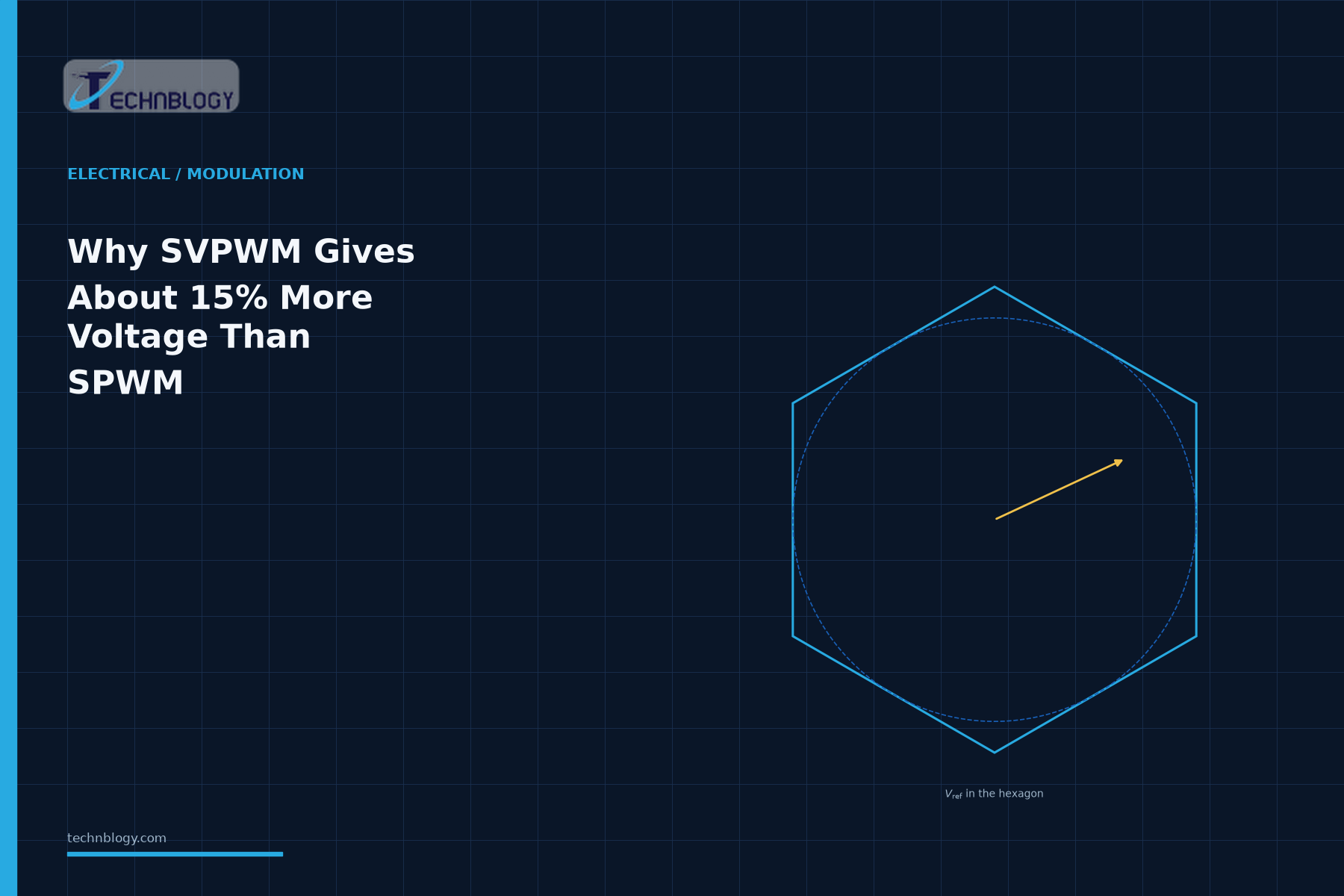
Relationships of DC line voltage, three-phase 6-step wave output, SPWM output and SVPWM output. Assuming `$$V_\mathrm{dc}$$` is DC voltage.

Electrical engineering notes: motors, modulation, power stages, and digital controllers.
Relationships of DC line voltage, three-phase 6-step wave output, SPWM output and SVPWM output. Assuming `$$V_\mathrm{dc}$$` is DC voltage.
Let the MCU (e.g., STM32) compiler automatically embed the firmware CRC32 for the bootloader’s integrity check. Two int32 values, crc32Value and crc32Value2, are reserved at the very end of FLASH. The check works the same way in every case: first verify crc32Value; if it is incorrect, check crc32Value2. If neither is correct, the program is faulty and the bootloader enters its error-handling stage.
For the three-phase PWM inverter, there are three commonly used coefficients to indicate the DC voltage utilization level, i.e. Modulation Level (调制度) M = \cfrac{V_R}{V_T} where V_R is the magnitude (note, not fundamental amplitude) of modulation wave, V_T is the Read more about The modulation index of pulse width modulation (PWM)